
GEOSYNTHETICS & ENGINEERING MATERIALS
Geosynthetics & Engineering Materials
Separate permeable textile functions from liquid containment, surface erosion protection and concrete-filled formwork. Start with the system position and site conditions, then review the relevant material construction.
6material families
13family / type records
9application briefs
8source documents
THE PLATFORM AT A GLANCE01 02 03 04
Define the engineering function. Then choose the material.
Soil / liquid conditions, temperature and exposure
Mechanical, hydraulic and interface requirements
Installation sequence, damage control and acceptance methods
01 / MATERIAL RANGE
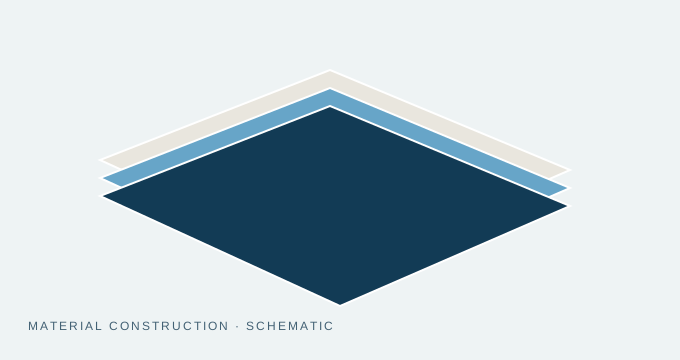
Know what belongs in this platform.
01 / MATERIAL FAMILY
Needle-Punched Geotextiles
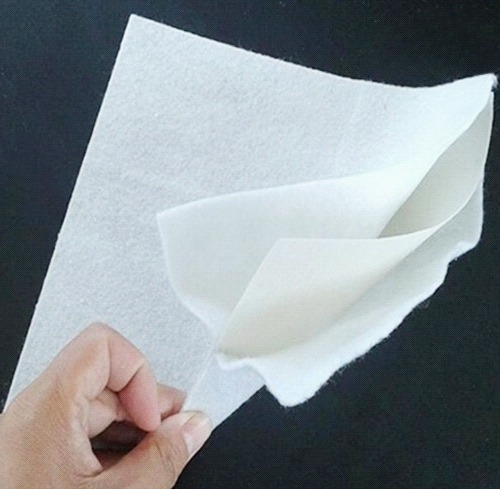
Compare needle-punched geotextiles for soil separation, filtration, drainage and membrane protection. Choose staple-fiber or continuous-filament construction around the soil, water flow and installation conditions.
Review construction, references & conditions ↗02 / MATERIAL FAMILY
HDPE Geomembranes
Explore HDPE geomembrane liners for water storage, aquaculture and environmental containment. Compare smooth, studded and spray-textured surfaces, then define thickness, roll size, contact media and seam requirements for your project.
Review construction, references & conditions ↗03 / MATERIAL FAMILY
Composite Geomembranes
Define a composite geomembrane by its membrane and textile layers, not total weight alone. Compare one-fabric and two-fabric structures for the containment and protection requirements of your project.
Review construction, references & conditions ↗04 / MATERIAL FAMILY
Cementitious Geosynthetic Mats
Review cementitious geosynthetic mats for channel lining and surface erosion protection. Compare thickness and backing options alongside hydration, curing, jointing and anchorage requirements.
Review construction, references & conditions ↗05 / MATERIAL FAMILY
Geotextile Ecological Bags
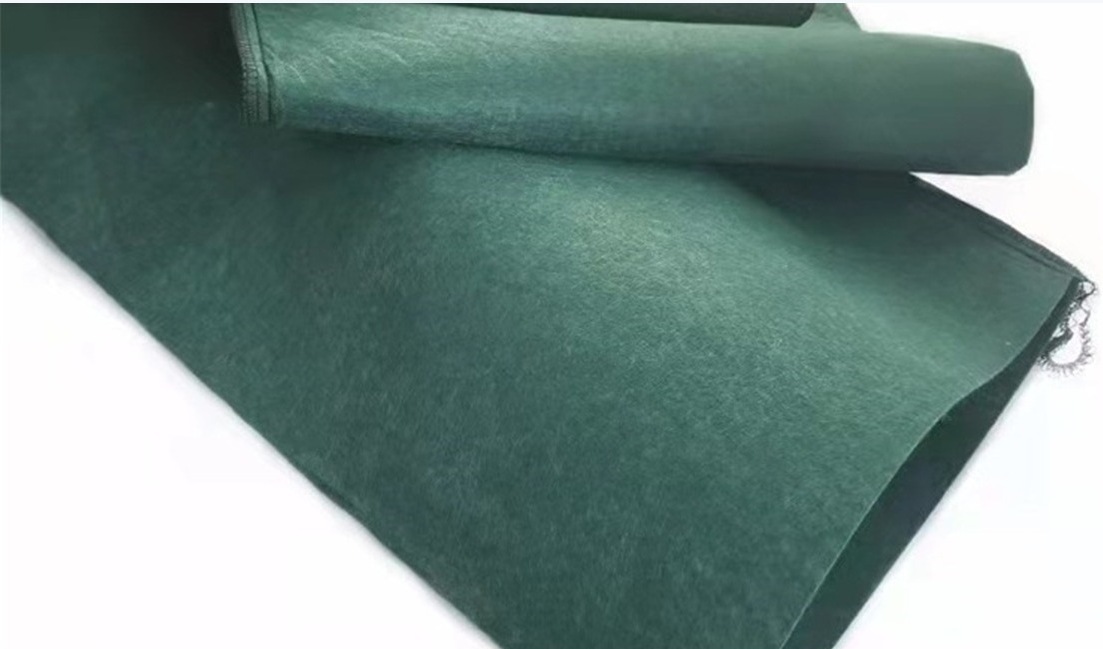
Explore needle-punched geotextile bags for slope surfaces, riverbanks and ecological restoration. Define fabric, bag size, filling, seams and site conditions before comparing supply options.
Review construction, references & conditions ↗06 / MATERIAL FAMILY
Geotextile Concrete Mattresses
Plan concrete-filled textile mattresses for hydraulic and revetment projects. Start with drawings, filling thickness, fabric connections and access conditions; the available description remains subject to technical confirmation.
Review construction, references & conditions ↗02 / SELECTION LOGIC
Choose by the job the material must do.
Separate, filter & protect
Soil grading, water transmission, pore size and construction damage need to be considered together.
Needle-Punched Geotextiles ↗Contain liquids
Define contact media, substrate, seams and interface conditions before choosing thickness or finish.
HDPE Geomembranes ↗Combine textile & membrane
Specify the polymer layer and each textile face separately; total mass alone does not define the construction.
Composite Geomembranes ↗Protect exposed surfaces
Confirm substrate, geometry, hydration, curing, jointing and anchorage.
Cementitious Geosynthetic Mats ↗Build ecological bag systems
Review bag dimensions, fill, seam closure, restraints and the vegetation plan.
Geotextile Ecological Bags ↗Plan filled fabric formwork
Use drawings, filling thickness, injection plan and access conditions to define the mattress. Textile formwork is not a cementitious mat.
Geotextile Concrete Mattresses ↗03 / REFERENCE ATLAS
Compare the right specification inputs.
| Material / type | Reference field | Supplied literature value |
|---|---|---|
| Needle-Punched Geotextiles | Fiber structures | Staple fiber / continuous filament |
| Needle-Punched Geotextiles | Mass | 100–800 g/m² reference; Chinese packaging image also states up to 1000 g/m² |
| Needle-Punched Geotextiles | Roll width | 1–6 m common; one short-fiber table states 1–7 m — confirm |
| HDPE Geomembranes | Thickness | 0.25–3.0 mm reference; options differ by finish and color |
| HDPE Geomembranes | Common thicknesses | 0.5 / 0.75 / 1.0 / 1.5 / 2.0 mm |
| HDPE Geomembranes | Width | 1–8 m; common 6 m |
| Composite Geomembranes | Fabric weight | 100–600 g/m² per layer, catalog reference |
| Composite Geomembranes | Membrane thickness | 0.2–1.5 mm, catalog reference |
| Composite Geomembranes | Roll width | 4.0–6.0 m reference |
| Cementitious Geosynthetic Mats | Reference thicknesses | 5 / 8 / 13 mm; thickness options, not approved model codes |
| Cementitious Geosynthetic Mats | Reference dry mass | 5–15 kg/m², structure dependent |
| Cementitious Geosynthetic Mats | Width / roll length | 1.0–3.0 m / 5–20 m reference |
| Geotextile Ecological Bags | Regular size | 40 × 80 cm reference |
| Geotextile Ecological Bags | Larger size | 50 × 100 cm reference; assess filled weight and handling |
| Geotextile Ecological Bags | Fabric mass | 100–250 g/m² selection reference |
| Geotextile Concrete Mattresses | Fabric material | PP or PET technical textile, subject to confirmation |
| Geotextile Concrete Mattresses | Dimensions / filling thickness | According to project drawings and structural design |
| Geotextile Concrete Mattresses | Filling ports / connections | Number, location and spacing to be confirmed |
| Staple-Fiber Needle-Punched Geotextile | Mass | 100–800 g/m² |
| Staple-Fiber Needle-Punched Geotextile | Thickness | 1.0–8.0 mm reference |
| Staple-Fiber Needle-Punched Geotextile | Nominal tensile classes | 3 / 5 / 8 / 10 / 15 / 20 / 25 / 30 / 40 kN/m; reference classes, not BOSHIDA model codes |
| Continuous-Filament Needle-Punched Geotextile | Mass | 100–800 g/m² reference |
| Continuous-Filament Needle-Punched Geotextile | Thickness | 0.8–4.5 mm in 17-page brochure |
| Continuous-Filament Needle-Punched Geotextile | Tensile reference table | 4.5–40 kN/m on source 07 P7; source 02 P4 states 6–54 — not interchangeable |
| Smooth HDPE Geomembrane | Supply range | Within the family brochure range; confirm finish-specific thickness, width and color |
| Smooth HDPE Geomembrane | Surface orientation | State the adjacent material on each face |
| Smooth HDPE Geomembrane | Verification | No project-specific interface shear or batch report supplied in this library |
| Studded HDPE Geomembrane | Supply range | Within the family brochure range; confirm finish-specific thickness, width and color |
| Studded HDPE Geomembrane | Surface orientation | State the adjacent material on each face |
| Studded HDPE Geomembrane | Verification | No project-specific interface shear or batch report supplied in this library |
| Spray-Textured HDPE Geomembrane | Supply range | Within the family brochure range; confirm finish-specific thickness, width and color |
| Spray-Textured HDPE Geomembrane | Surface orientation | State the adjacent material on each face |
| Spray-Textured HDPE Geomembrane | Verification | No project-specific interface shear or batch report supplied in this library |
| One-Fabric Composite Geomembrane | Layer arrangement | 1 geotextile + 1 geomembrane (1T1M) |
| One-Fabric Composite Geomembrane | Membrane thickness | 0.2–1.5 mm catalog reference; confirm the selected structure |
| One-Fabric Composite Geomembrane | Fabric mass | 100–600 g/m² per layer, catalog reference; specify each fabric face separately |
| Two-Fabric Composite Geomembrane | Layer arrangement | 2 geotextiles + 1 geomembrane (2T1M) |
| Two-Fabric Composite Geomembrane | Membrane thickness | 0.2–1.5 mm catalog reference; confirm the selected structure |
| Two-Fabric Composite Geomembrane | Fabric mass | 100–600 g/m² per layer, catalog reference; specify each fabric face separately |
Read the full product table before specifying a grade. Do not combine upper limits across rows, variants or source versions. No approved model code is inferred from these ranges.
04 / APPLICATIONS
Continue in the application context.
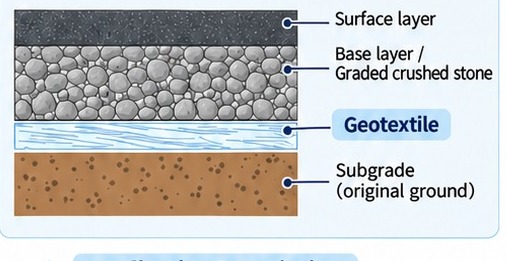
Application brief
Roads & Railways
Keep granular layers separated from the subgrade while addressing filtration and construction damage.
Explore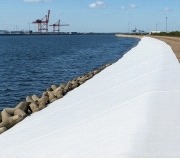
Application brief
Water Storage & Canal Systems
Define whether the task is liquid containment, filter protection, surface erosion control or a combination.
Explore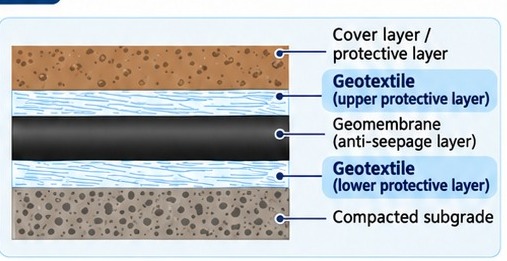
Application brief
Mining & Environmental Containment
Separate barrier performance, mechanical protection and drainage in waste or mining systems.
Explore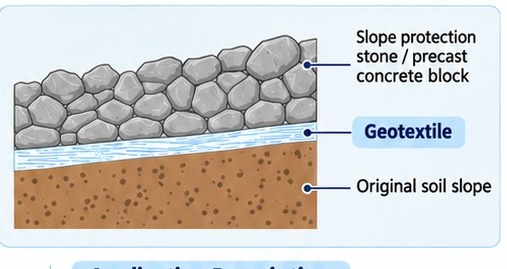
Application brief
Slopes, Riverbanks & Coastal Protection
Choose the protection system around erosion, hydraulic conditions and slope stability.
Explore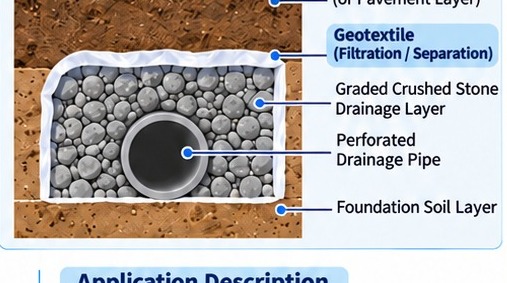
Application brief
Municipal & Subsoil Drainage
Limit migration of fine soil into granular drainage and perforated-pipe systems.
Explore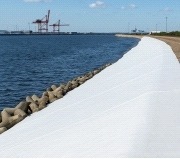
Application brief
Aquaculture & Landscape Water Storage
Identify a liner construction compatible with pond geometry, water quality and maintenance.
Explore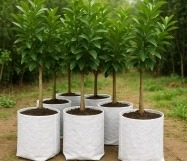
Application brief
Geobags for Ecological Restoration
Use a filled-bag configuration with compatible planting media and surface protection.
Explore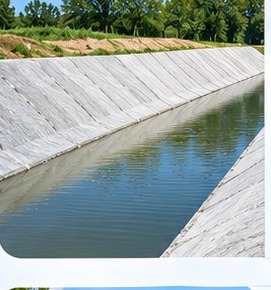
Application brief
Cementitious Mats for Channel Protection
Review an installable mat together with hydration, curing and hydraulic exposure.
Explore09 / APPLICATION
Application brief
Concrete-Filled Fabric Formwork for Revetments
Plan textile formwork geometry and controlled filling for the specified revetment.
Explore05 / DOCUMENTS & EVIDENCE
Build a useful technical package.
Editable selection briefs
Fill the inputs you know. A request worksheet is different from a data sheet or test report.
Needle-Punched Geotextiles brief ↗HDPE Geomembranes brief ↗Composite Geomembranes brief ↗Cementitious Geosynthetic Mats brief ↗Geotextile Ecological Bags brief ↗Geotextile Concrete Mattresses brief ↗Released original literature
Open the document record to check language, version and material scope.
HDPE Geomembranes — English Brochure ↗HDPE Geomembranes — Chinese Brochure ↗Geotextile Ecological Bags Brochure ↗Grade-specific evidence
Request the offered identifier, effective TDS, sample or batch results and permission to share. Certification and complete-system performance require their own evidence.
Request the applicable documents ↗How to review evidence ↗SUPPLIED SOURCE LIBRARY
Where the platform information comes from.
Engineering & Infrastructure Material Guide ↗Needle-Punched Geotextile Product Brochure ↗HDPE Geomembranes — English Brochure ↗HDPE Geomembranes — Chinese Brochure ↗Cementitious Mat Review Brochure ↗Geotextile Ecological Bags Brochure ↗Composite Geomembrane Description — Working Draft ↗Concrete Mattress Description — Working Draft ↗
06 / BUYER GUIDANCESearch all buyer questions ↗
Understand the differences before you request a grade.
01 / BUYING GUIDE
Technical resources
PET or PP Geotextile: Define the Environment Before the Polymer
Choose PET or PP geotextile against the contact environment and the required function, not the polymer name alone. PET means polyester and PP means polypropylene. Neither label identifies the complete finished-fabric specification. For a purchasing decision, separate the chemistry question from hydraulic and mechanical qualification: a material considered suitable for the exposure still needs evidence for its separation, filtration or protection duty.
Explore02 / BUYING GUIDE
Technical resources
Smooth or Textured HDPE: Start with the Contact Interfaces
Choose smooth or textured HDPE geomembrane from the interfaces in the designed lining system. Name the material touching each face, the location on the drawing and the relevant loading and moisture conditions. Texture is a surface configuration; its appearance alone does not demonstrate interface resistance or establish that a slope is safe.
Explore03 / BUYING GUIDE
Technical resources
Specify Composite Membrane Layers Instead of Total Mass Alone
Specify a composite geomembrane layer by layer: membrane material and thickness, fabric identity and mass per area on each side, overall dimensions and the intended joining detail. A total mass such as “500 g/m² composite” does not uniquely identify the barrier layer or establish that two offered constructions are equivalent.
ExploreExplore 11 more related guides
01 / BUYING GUIDE
Technical resources
Cementitious Mat Procurement: Specify the Site Before Thickness
A cementitious mat enquiry should begin with the site and the intended protection task, then move to the proposed thickness and delivery configuration. A thickness label does not establish hydraulic performance, impermeability, anchorage or the conditions needed for installation. The following brief helps a buyer obtain a reviewable offer rather than a catalogue-only price.
Explore02 / BUYING GUIDE
Technical resources
Staple Fiber or Continuous Filament: Compare the Actual Specification
Choose staple-fibre or continuous-filament needle-punched geotextile by comparing the offered constructions against the project duty. Staple fibres form one type of entangled web; continuous filaments form another. Those names describe construction, not a universal ranking in strength, filtration performance or long-term suitability.
Explore03 / BUYING GUIDE
Technical resources
Reading a Geotextile Table: Strength, Puncture, Opening Size and Flow
Read a geotextile table as a set of separate answers: mass and thickness describe aspects of construction; tensile and puncture address different mechanical questions; opening size and flow data address different hydraulic questions. A purchasing decision should match each required property to its method, units, value basis and offered grade. A single mass or strength number cannot replace that schedule.
Explore04 / BUYING GUIDE
Technical resources
Protecting a Geomembrane: Below, Above or Both Sides
Identify the contact being protected before deciding whether a geomembrane needs geotextile below, above or on both sides. A lower layer and an upper layer can address different damage exposures. Their positions, constructions and acceptance basis should follow the lining-system design; fabric weight alone cannot approve the protection arrangement.
Explore05 / BUYING GUIDE
Technical resources
Studded or Spray-Textured: What Evidence Makes a Fair Comparison?
Studded and spray-textured geomembranes have visibly different surface patterns, but a texture name or photograph does not establish which finish is appropriate for a project interface. Compare the offered membrane, the actual contact pair and the supporting test conditions. Treat the surface description as product identification, not an automatic ranking of stability.
Explore06 / BUYING GUIDE
Technical resources
HDPE Resin, Thickness and Color: Three Separate Procurement Decisions
Resin requirements, membrane thickness and colour are three separate decisions in an HDPE geomembrane enquiry. None of them alone proves overall quality or suitability for a particular liquid or exposure. Specify what each field is intended to control, then link the offered construction to the appropriate product documents and project evidence.
Explore07 / BUYING GUIDE
Technical resources
Geomembrane Installation Review: Deployment, Welding and Seams
A geomembrane installation review should distinguish prepared-base acceptance, panel deployment, joining and seam verification. Material procurement and installation quality are related but are not interchangeable. A factory product report does not establish that a field seam or a completed lining area has been accepted. The project’s approved installation and quality documents must identify who checks each stage.
Explore08 / BUYING GUIDE
Technical resources
Hydration Is Not Just Surface Setting: What to Confirm
For a cementitious mat, wetting the visible surface, initial setting, internal hydration and later strength development are not the same observation. Procurement and site planning should identify the applicable product instructions, water provision, environmental conditions and the point at which a specified result will be assessed. This guide explains what to confirm; it is not a hydration recipe.
Explore09 / BUYING GUIDE
Technical resources
Geobag Procurement: Size, Fabric Weight, Seams and Fill
An ecological geobag purchase should specify the finished bag, not just the fabric mass or flat dimensions. Bag size, seam and closure arrangement, intended fill and handling conditions belong in the same brief. A larger bag cannot be qualified by scaling the smaller bag’s dimensions while assuming the same performance.
Explore10 / BUYING GUIDE
Technical resources
Geobag Installation: From Short-End Closure to Vegetation Care
Plan ecological-bag installation around the approved slope arrangement, drainage, fill, closure and placement details. Ordering the right fabric or bag size does not define the completed structure. The following coordination checklist separates material supply from the designer’s and installer’s project responsibilities; it is not a slope-stability design.
Explore11 / BUYING GUIDE
Technical resources
A Sample Test Report Is Different from a Brochure Range
A sample test report describes the specimen and tests identified in that report. A brochure describes a product family or claimed capability. Procurement needs both context and traceability: identify what was tested, what is being offered and which project requirements the evidence actually answers. Neither a laboratory logo nor a strong result fills in missing scope.
ExploreQuestions for this material platform
What should I compare when selecting a needle-punched geotextile?
Identify the material, short-staple or continuous-filament construction, intended function, dimensions and specified tests. PET or PP and mass per area alone do not define suitability.
Read the geotextile selection guide ↗Is a smooth or textured geomembrane right for my project?
The choice depends on the project design and material interfaces. Provide the slope, contacting materials, exposure and project specification; surface texture and material formulation are separate decisions.
Review liner selection factors ↗What should I identify before selecting needle-punched geotextiles?
PET or PP nonwoven geotextiles with mechanically interlocked fibers. Staple-fiber or continuous-filament web formation and needle punching. The offered composition and construction should be recorded against a sample or approved specification, rather than inferred from a generic product name. Separation;Filtration;Protection;Soil grading, hydraulic conditions, installation loads and material chemistry determine the specification. Compare candidates under the same application conditions. Material weight alone does not establish equivalent performance.
Review construction, conditions & sources ↗What evidence should I request for needle-punched geotextiles?
Mass, thickness, tensile and elongation, CBR puncture, tear, opening size and permeability. Request the applicable method, specimen direction, conditioning and test scope. A published reference range is different from a measured sample result. A geotextile is permeable and does not replace a geomembrane barrier. Do not infer reinforcement capacity, long-term service life or chemical compatibility from the product family name. Width and mass limits differ between supplied pages.
Review construction, conditions & sources ↗What should I identify before selecting hdpe geomembranes?
High-density polyethylene sheet used as a containment barrier. Smooth, studded or spray-textured roll goods with one- or two-sided surface options. The offered composition and construction should be recorded against a sample or approved specification, rather than inferred from a generic product name. Containment;Protection;Interface stability;Identify adjacent layers, slope, cover load, contact medium, temperature and exposure. Compare candidates under the same application conditions. Material weight alone does not establish equivalent performance.
Review construction, conditions & sources ↗What evidence should I request for hdpe geomembranes?
Thickness tolerances, tensile yield/break, tear, puncture, durability, media compatibility and seam acceptance. Request the applicable method, specimen direction, conditioning and test scope. A published reference range is different from a measured sample result. Containment depends on the installed system and seam quality. Color, thickness and visible texture do not independently prove quality, drinking-water suitability or interface resistance. Referenced GH categories are not enterprise SKU approvals.
Review construction, conditions & sources ↗07 / YOUR NEXT STEP
Turn the use into a comparable material brief.
Identify the construction and application. Record the dimensions, conditions, required tests, quantity and destination. Confirm the proposed grade, evidence and supply scope before ordering.