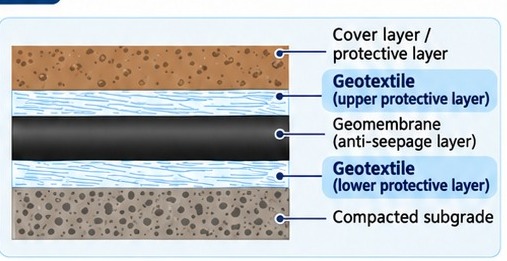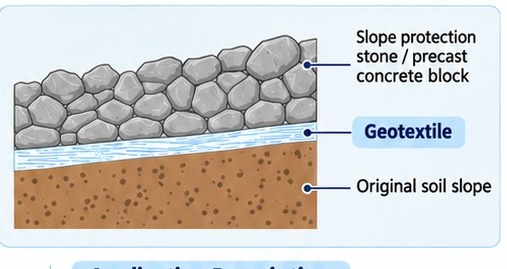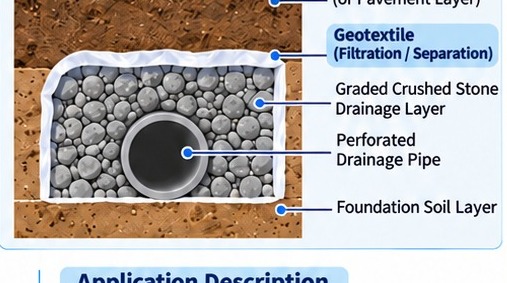
Identify the contact being protected before deciding whether a geomembrane needs geotextile below, above or on both sides. A lower layer and an upper layer can address different damage exposures. Their positions, constructions and acceptance basis should follow the lining-system design; fabric weight alone cannot approve the protection arrangement.
What is the lower protection layer expected to address?
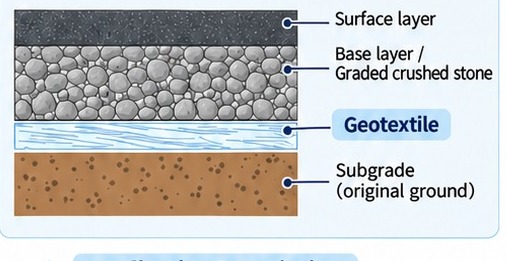
Describe the prepared subgrade and the membrane’s contact with it. Identify particles, irregularities and installation actions that the designer must consider. A protective fabric is not permission to leave unsuitable sharp objects or an unprepared base. The substrate preparation and the protection material are separate parts of the construction scope.
Ask for the specified lower-layer position and material requirement. Make sure receiving and installation documents identify that layer rather than referring only to “geotextile for the project.”
Why is the upper layer a separate decision?
Cover placement creates a different interface: the material above the membrane, its grading and the way it is placed matter to the review. Where the design calls for upper protection, specify it independently from the lower layer. There is no assumption that a fabric approved below the membrane is also approved for every cover condition.
A double-sided layout can therefore contain two different schedules. Keep the drawing orientation and the intended contact for each fabric clear when requesting samples and quantities.
Which evidence should support a protection offer?
Describe the membrane, adjacent materials and relevant loads or placing conditions, then ask the project designer for the evaluation basis. Mechanical fabric properties help characterise a candidate, but they do not automatically establish the behaviour of the complete contact system.
Clarify responsibility for seams, overlaps, temporary exposure and cover placement through the applicable project documents. This guide provides no universal protective mass, placement thickness or permitted construction load.
Example: avoid purchasing one undifferentiated fabric quantity
A drawing calls for separate lower and upper protection. Split the RFQ into those two positions with their respective requirements and quantities. If a supplier proposes one grade for both, ask for a written comparison against each duty. Do not collapse the two line items solely because the materials look similar.
Next step
Attach a lining-system section to enquiries for HDPE geomembrane and needle-punched geotextile. For composite supply, use the layer specification guide.
Frequently asked questions (FAQ)
Can geotextile replace the impermeable membrane?
No such replacement is established here. The protection fabric and the barrier have different roles. Any proposed system change requires review of the actual containment design.
Does higher mass guarantee membrane protection?
No. The relevant contact conditions and system evaluation must be considered. Mass can identify a candidate construction but is not, by itself, proof of protection.
Can I omit the upper layer if the cover looks smooth?
Do not make that change from appearance alone. Ask the designer to review the actual cover, placement method and original protection requirement.
What if the delivered fabric is not labelled by position?
Resolve its identity against the order and layer schedule before use. Ask the supplier and project contact to confirm which delivered grade is assigned to each location.
Should upper and lower protection fabrics be separate order items?
Separate line items are useful when their positions, specifications or quantities differ. If one grade is proposed for both, ask for confirmation against both duties. The purchasing schedule should preserve the distinction shown in the lining design.
Can a protection-fabric report be reused after changing the cover aggregate?
Do not assume it answers the changed contact condition. Identify the new material and placement conditions and ask the designer which protection evidence must be reconsidered. This guide supplies no universal aggregate limit.
Source & applicability
Supplier literature supports this selection brief. Reference ranges do not establish an approved grade, certification or tested system performance.
Technical documents & media
HDPE Geomembranes — English Brochure
Smooth, studded and spray-textured HDPE, dimensions, reference GH tables, protective layers, composite structures, installation and selection FAQ. Illustrative external project images are not BOSHIDA case evidence.
Download technical document (PDF)
View in technical resourcesHDPE Geomembranes — Chinese Brochure
Chinese companion literature covering HDPE finishes, reference data, installation and composite-layer selection. It is a language source, not a separately approved technical specification.
Download technical document (PDF)
View in technical resources