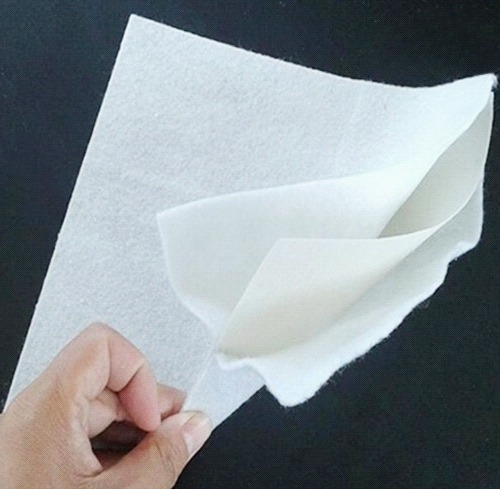
Specify a composite geomembrane layer by layer: membrane material and thickness, fabric identity and mass per area on each side, overall dimensions and the intended joining detail. A total mass such as “500 g/m² composite” does not uniquely identify the barrier layer or establish that two offered constructions are equivalent.
Which values identify the actual construction?
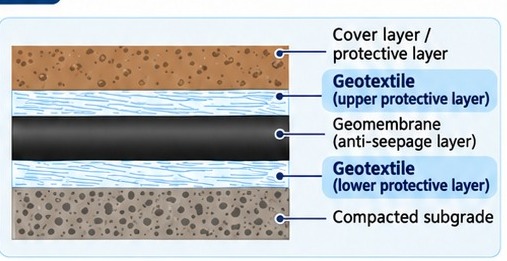
The supplied literature describes one-fabric/one-membrane and two-fabric/one-membrane arrangements. For procurement, name the upper and lower sides and identify the layer sequence relative to the installation. Use millimetres for membrane thickness and g/m² for each fabric mass, with tolerances and test or measurement references where specified.
Keep total mass as an additional descriptive field. It should not replace the individual layers. Ask whether the quotation covers a factory-bonded combination or separately supplied components; these are different delivery boundaries.
How do you compare an alternative build-up?
Start with the drawing and intended containment/protection duties. Compare the membrane layer, then each fabric and the combination’s processing or connection requirements. Do not convert more fabric mass into assumed membrane thickness. A stronger fabric result also does not establish barrier integrity.
If a supplier proposes a different layer arrangement, show the complete alternative and ask the project technical contact to review the affected functions. A price comparison should say which construction and joining work each offer includes.
Why must edges and connections be discussed early?
The usable panel and its connections belong to the procurement scope. Ask how the membrane connection will be accessed, what supplied edge configuration is included and which installation document applies. Do not invent an overlap or welding recipe from the overall composite name.
Record the approved structure and delivery format with the quotation so receiving staff can distinguish the specified composite from a visually similar roll with a different membrane layer.
A useful RFQ format
Write: upper fabric [construction and mass] / membrane [polymer, thickness and tolerance] / lower fabric [construction and mass], followed by width, length and edge/joining requirements. Leave unconfirmed entries visible. This notation is an enquiry format, not a claim that every combination is available or suitable.
Next step
Attach a layer schedule to your composite geomembrane enquiry and review the membrane protection layout before selecting adjacent fabrics.
Frequently asked questions (FAQ)
Can two composites have the same total mass but different membrane thickness?
A total mass does not determine how mass is distributed between layers. Request the actual layer schedule; do not calculate membrane thickness from an unidentified total.
Does the term geocomposite always mean fabric plus membrane?
No procurement decision should rely on that broad label alone. Identify the actual constituent layers. A GCL or drainage composite should not be relabelled as the specified fabric-membrane construction.
Can one test report qualify every layer?
Read the tested object and scope. A fabric, membrane or combined specimen report answers different questions. Identify which requirements remain unsupported rather than treating one report as universal approval.
Can the structure be changed after sample approval?
Treat a changed membrane or fabric layer as a defined change request. Ask the responsible technical contact what needs reassessment, and update the layer schedule before accepting bulk supply.
Should a composite-liner quotation include the connection work?
Ask explicitly. A roll-material price may exclude edge preparation, joining consumables or installation work. Compare the quoted layer build-up and included operations separately; do not assume the word composite identifies the complete installed scope.
How should the supplier identify the two fabric faces?
Use the buyer’s drawing references or clearly agreed upper/lower labels, together with each fabric’s construction and mass. Keep those labels consistent across the offer, sample and installation documents so the two sides are not silently interchanged.
Source & applicability
Supplier literature supports this selection brief. Reference ranges do not establish an approved grade, certification or tested system performance.
Technical documents & media
HDPE Geomembranes — English Brochure
Smooth, studded and spray-textured HDPE, dimensions, reference GH tables, protective layers, composite structures, installation and selection FAQ. Illustrative external project images are not BOSHIDA case evidence.
Download technical document (PDF)
View in technical resourcesHDPE Geomembranes — Chinese Brochure
Chinese companion literature covering HDPE finishes, reference data, installation and composite-layer selection. It is a language source, not a separately approved technical specification.
Download technical document (PDF)
View in technical resources