A geomembrane installation review should distinguish prepared-base acceptance, panel deployment, joining and seam verification. Material procurement and installation quality are related but are not interchangeable. A factory product report does not establish that a field seam or a completed lining area has been accepted. The project’s approved installation and quality documents must identify who checks each stage.
What must be ready before panels are deployed?
Confirm the accepted base condition, panel layout, proposed material identification and any protection layers shown on the drawing. Record the intended orientation where a face or texture is specified. Establish how roll labels and panel identities will be retained after cutting. These are coordination questions; this article does not approve a subgrade or supply a site safety plan.
If the base or adjacent layer differs from the design, resolve the change before assuming that the purchased membrane remains suitable for the revised contact.
Which joining decisions require product-specific documents?
Identify the joining process, the offered membrane construction and the applicable installation procedure. For fabric-membrane composites, discuss how the membrane connection will be accessed and how the fabric edge is treated. A generic overlap illustration does not provide a welding temperature or acceptance criterion.
The responsible installer and project quality contact should define the required trial, inspection and test records. Keep process settings and conditions attached to the actual work record rather than treating a supplier catalogue as a completed field procedure.
What is the difference between material QC and site acceptance?
Factory quality control can describe an identified material and its tests. Site acceptance addresses the delivered panels, their joining and the work performed under project conditions. Connect both records through material and panel identities, while keeping their scopes separate.
Plan how observations, nonconformities, repairs and rechecks will be recorded. An installed area should not be treated as accepted merely because the roll has a certificate or the seam appears continuous. The applicable project documents determine the release process.
Illustrative hold point
A crew has the specified membrane but the panel drawing shows a different face orientation from the delivery plan. The useful response is to stop that decision from becoming an undocumented assumption: identify the affected panels, obtain the responsible clarification and update the work record. This example supplies no universal work-stop rule or repair instruction.
Next step
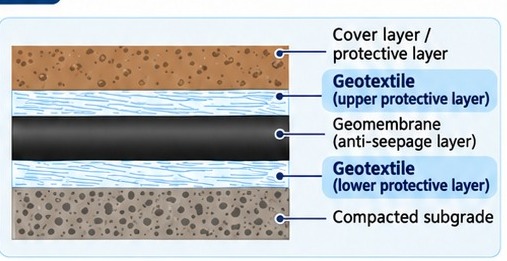
Bring the panel plan and inspection responsibilities to your HDPE liner discussion. Check the protection layer arrangement separately before installation.
Frequently asked questions (FAQ)
Can the supplier provide one welding temperature for all sites?
A universal value is not established here. Ask for the offered product’s instructions and have the qualified installation team determine and verify the procedure for the actual conditions.
Does a factory report cover the field seam?
Not unless its stated scope actually concerns that seam, which a normal roll-material report does not establish. Request the separate field joining and acceptance records required by the project.
Can an installation photograph prove lining integrity?
A photograph can document visible conditions and location, but it cannot replace the specified inspection or test evidence. Keep it with the relevant panel and work records.
What happens after a repair?
Follow the project’s applicable repair and recheck process and retain the location and result. Do not infer acceptance from this general guide or use it as a repair method.
What should a receiving record link to the panel plan?
Retain the delivered product and roll identities that the project uses to trace panels and work records. The actual naming system should follow the project documents. Traceability helps connect material evidence to the installed locations without treating it as seam approval.
Can a material supplier’s price be treated as an installation offer?
Not unless the scope actually includes installation. Ask which deployment, joining, inspection and repair responsibilities are included or excluded. A material-only quote should not silently become a commitment for completed lining work.
Source & applicability
Supplier literature supports this selection brief. Reference ranges do not establish an approved grade, certification or tested system performance.
Technical documents & media
HDPE Geomembranes — English Brochure
Smooth, studded and spray-textured HDPE, dimensions, reference GH tables, protective layers, composite structures, installation and selection FAQ. Illustrative external project images are not BOSHIDA case evidence.
Download technical document (PDF)
View in technical resourcesHDPE Geomembranes — Chinese Brochure
Chinese companion literature covering HDPE finishes, reference data, installation and composite-layer selection. It is a language source, not a separately approved technical specification.
Download technical document (PDF)
View in technical resources