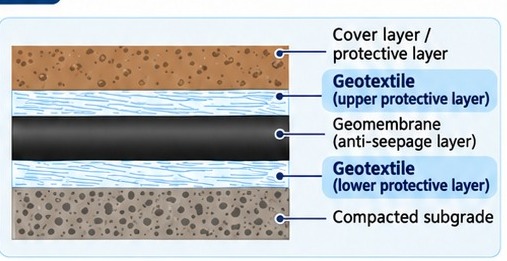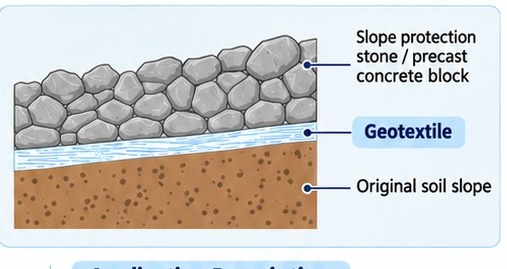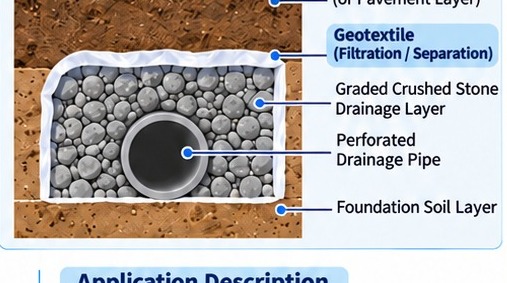
Choose PET or PP geotextile against the contact environment and the required function, not the polymer name alone. PET means polyester and PP means polypropylene. Neither label identifies the complete finished-fabric specification. For a purchasing decision, separate the chemistry question from hydraulic and mechanical qualification: a material considered suitable for the exposure still needs evidence for its separation, filtration or protection duty.
Which exposure information changes the material discussion?
Describe the liquid or soil that contacts the fabric, expected temperature and moisture, duration of exposure and whether the roll will remain uncovered. Where chemical exposure is a concern, provide the available composition or site analysis instead of describing the environment only as “industrial” or “acid-resistant.” The supplied geobag literature calls for specific durability review in demanding exposure conditions; it does not support a universal service-life promise for either polymer.
Ask the supplier to identify the offered fibre composition and any stabilisation relevant to the stated exposure. A generic chemical-resistance statement is a question to investigate, not an approval for an unidentified liquid.
How do you compare two qualified candidates?
Give both suppliers the same engineering function and property schedule. For a filtration duty, keep the opening-size and water-flow requirements visible. For a protection duty, identify contact materials and installation loading. Compare the reported properties under matching methods and specimen conditions. A fabric with greater mass per area is not automatically the safer chemical choice, and changing polymer does not remove the need to verify the fabric structure.
Keep exposure evidence and routine product tests in separate rows so that a strong tensile result cannot accidentally stand in for durability information.
What should the offer and acceptance record contain?
Request the proposed grade or construction, composition, applicable specification revision, exposure assumptions and evidence actually available. Put unresolved compatibility questions beside the quotation rather than dropping them after the price is received. The project designer or designated technical contact should decide whether the documented evidence meets the intended application.
When the contact environment changes, reopen the relevant exposure question. Approval for one location or liquid should not silently be carried into another project.
Worked purchasing example: same mass, different evidence
A buyer receives two offers described as 300 g/m² geotextile, one PET and one PP. The useful comparison is not a vote for a polymer: first identify the actual contact environment, then compare the same filtration or protection requirements. If one offer includes only a general brochure and the other includes a relevant material assessment, record that evidence difference. This is an illustrative comparison, not a tested BOSHIDA grade.
Next step
Prepare an exposure brief and a function-specific property schedule before requesting a needle-punched geotextile offer. For construction choices, continue with staple fibre versus continuous filament.
Frequently asked questions (FAQ)
Does PP automatically mean UV-resistant?
No. Ask what outdoor exposure the offered construction is intended for and which evidence supports it. A PP label alone does not identify stabilisation, exposure conditions or a guaranteed outdoor lifetime.
Can PET and PP offers use the same property schedule?
They can be compared against the same project requirements, but the schedule must include the function, methods and environmental conditions. Do not assume one polymer can replace the other without reviewing the offered construction.
What if the liquid composition is not yet known?
Mark chemical suitability as unresolved and obtain the missing site information. Ask the project technical contact what can be evaluated provisionally; do not turn “unknown” into a supplier compatibility guarantee.
Can recycled content be accepted on the basis of colour?
No. Colour does not establish feedstock or traceability. If recycled content matters to the purchase, specify what declaration and supporting records are required for the offered product.
Can I compare PET and PP quotations if only one includes exposure evidence?
Record the evidence gap before ranking the offers as equivalent. Give both suppliers the same contact-environment brief and ask which documents support their offered construction. A cheaper price does not resolve an unanswered compatibility requirement.
Does choosing the polymer settle filtration performance?
No. Keep the soil-filter and water-flow requirements separate from the composition decision. A PET or PP description identifies a material input; it does not establish the offered fabric’s opening size, hydraulic performance or compatibility with the project soil.
Source & applicability
Supplier literature supports this selection brief. Reference ranges do not establish an approved grade, certification or tested system performance.
Technical documents & media
Geotextile Ecological Bags Brochure
Needle-punched geobag construction, dimensions, reference fabric weights, fill and seam details, installation and ecological-restoration conditions. Quality-control recommendations are not certification.
Download technical document (PDF)
View in technical resources