Read a geotextile table as a set of separate answers: mass and thickness describe aspects of construction; tensile and puncture address different mechanical questions; opening size and flow data address different hydraulic questions. A purchasing decision should match each required property to its method, units, value basis and offered grade. A single mass or strength number cannot replace that schedule.
Which table fields must stay together?
Keep the property name, method, units, specimen direction, value and qualification notes in the same row. A tensile figure without its method or direction is incomplete for comparison. A permeability-related figure without its stated quantity and units should not be renamed simply “drainage.”
The company’s short-fibre table uses nominal tensile groupings, while the continuous-filament table uses mass columns. That is a reason to identify the proposed grade before copying values. It does not establish that matching column positions describe equivalent products.
How do mechanical and hydraulic requirements interact in procurement?
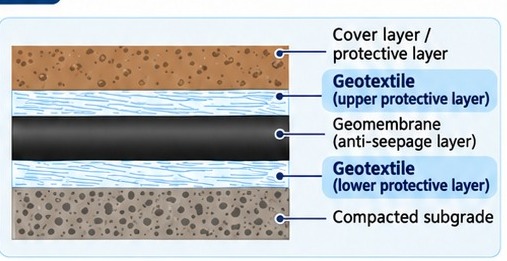
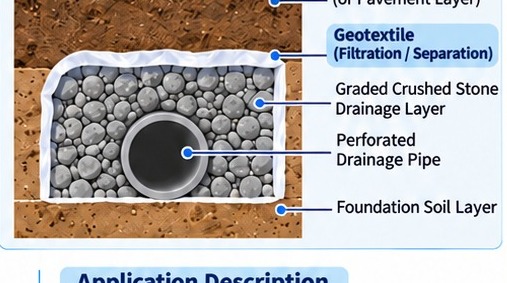
Ask the designer which properties control the application. A membrane-protection enquiry needs evidence for the protection task; a soil-filter enquiry needs soil compatibility as well as flow requirements. A larger puncture result does not answer an opening-size question. Increasing fabric mass also does not, by itself, approve the hydraulic design.
Opening size and water transmission should remain separate fields. Ask for the exact stated measure and test basis instead of comparing values with different labels as if they were the same quantity.
How can you avoid creating a product that does not exist?
Use a single proposed specification row or grade, with the applicable revision. Do not take the highest strength from one column, the smallest opening from another and the widest roll from a different document. Ask which combination is offered together and which values are supported by representative results.
Where the table states a range for a product family, request the value basis for the chosen grade. A family range is useful for screening but is not a guarantee for every shipment.
A practical comparison worksheet
Use columns headed project requirement, offered grade, reported value, method/conditions and evidence gap. If offer A provides an opening-size field but offer B omits it, the correct entry is “not provided,” not zero and not a value inferred from mass. This makes the unresolved decision visible before prices are ranked.
Next step
Bring a completed comparison worksheet to the geotextile enquiry and use sample report versus brochure to check the evidence behind each entry.
Frequently asked questions (FAQ)
Are typical values the same as guaranteed minimums?
No. Read the value basis and notes. Ask the supplier to identify which entries are descriptive, specified limits or sample results and agree what the purchasing acceptance document will use.
Can kN/m be compared directly with a result in N?
Do not compare the numbers without identifying the test and specimen basis. Different expressions can describe different test configurations; a unit conversion alone may not make them equivalent.
Does a smaller opening always mean a better filter?
That conclusion needs soil and hydraulic design information. Keep retention and water-flow questions together and ask the designer to evaluate compatibility for the project.
Can a standards list replace a product test report?
No. A list shows a claimed reference framework, not the result of testing the offered specimen. Ask which method, edition and sample record actually support the required property.
What should I do when machine and cross-direction results differ?
Retain both directions and their labels. Ask which requirements apply in each direction under the project specification. Do not select only the stronger direction or average away a difference without an agreed technical basis.
Why should the offered grade be named on the comparison sheet?
A family table can contain multiple constructions or value ranges. Naming the offered grade links the quotation to a particular specification and evidence set, reducing the risk of comparing a price for one option with properties taken from another.
Source & applicability
Supplier literature supports this selection brief. Reference ranges do not establish an approved grade, certification or tested system performance.