
Needle-Punched Geotextiles
Compare needle-punched geotextiles for soil separation, filtration, drainage and membrane protection. Choose staple-fiber or continuous-filament construction around the soil, water flow and installation conditions.
Choose within Needle-Punched Geotextiles.
Compare construction and intended position first, then open the individual type for its reference parameters, sources, limitations and procurement questions. Product types are not approved commercial model codes.
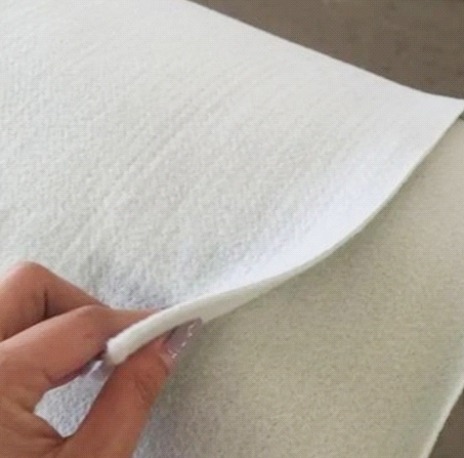
Staple-Fiber Needle-Punched Geotextile
Review staple-fiber needle-punched geotextile for separation, filtration and protection layers. Compare soil retention, water transmission and installation resistance before choosing a mass or tensile class.
Explore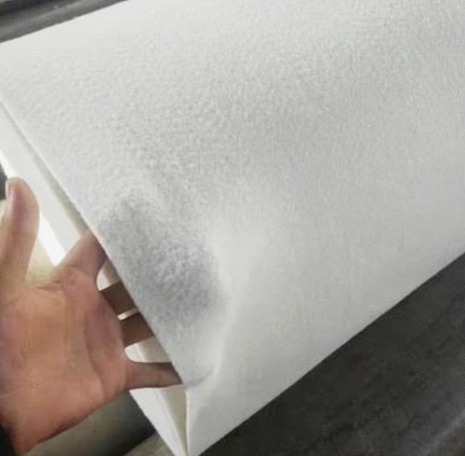
Continuous-Filament Needle-Punched Geotextile
Explore continuous-filament needle-punched geotextile for membrane protection, filtration and separation. Compare the proposed fiber construction with puncture, hydraulic and installation requirements.
Explore| Product type | Construction | Intended use | What changes the selection | Next step |
|---|---|---|---|---|
| Staple-Fiber Needle-Punched Geotextile | PET or PP staple fibers forming a porous mechanically interlocked web | Road separation, drainage filtration, slope filters and protection layers | Compare the offered PET or PP construction against the specified opening-size and mechanical tests. Confirm notation and test method for the reported pore-size figure; reference tensile classes are not automatically matched to every fabric mass. | Prepare this type’s brief ↗ |
| Continuous-Filament Needle-Punched Geotextile | Continuous-filament nonwoven geotextile; confirm PET or PP for the offered construction | Geomembrane protection, road and railway layers, hydraulic works and mining systems | Review one consistent specification and sample. The supplied versions contain different mechanical ranges, so compare candidates under the same test conditions rather than merging figures from separate documents. | Prepare this type’s brief ↗ |
Comparison content is derived from the linked product records. No combined maximum specification or automatic interchangeability is implied.
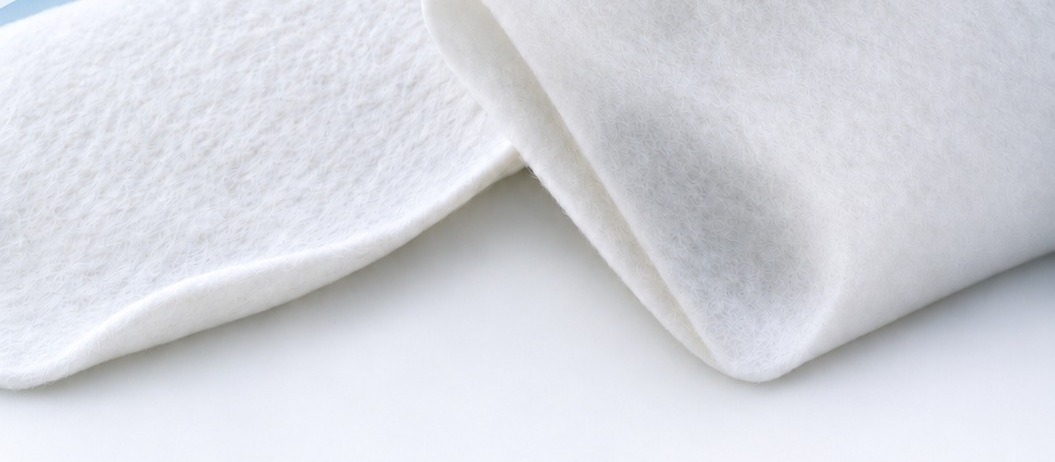
Supplied brochure image. Material / use reference; confirm the offered configuration.
| Construction | PET or PP nonwoven geotextiles with mechanically interlocked fibers |
|---|---|
| Supply / process | Staple-fiber or continuous-filament web formation and needle punching |
| Intended uses | Separation, filtration, auxiliary drainage and geomembrane protection |
| Commercial model | Not established in the supplied literature; confirm the offered grade |
| Data status | Brochure references; not guaranteed values or batch test results |
Catalogue references are not guaranteed performance values. Confirm the offered grade, test methods and supply responsibilities in the quotation.
Supplier literature: specification inputs
These are stated brochure ranges for preliminary review, not a guaranteed combination or an approved commercial model. Confirm the selected construction, tolerances, test method and acceptance criteria.
| Property / configuration | Literature reference |
|---|---|
| Fiber structures | Staple fiber / continuous filament |
| Mass | 100–800 g/m² reference; Chinese packaging image also states up to 1000 g/m² |
| Roll width | 1–6 m common; one short-fiber table states 1–7 m — confirm |
| Roll length | 50–200 m reference |
Material and construction
PET or PP nonwoven geotextiles with mechanically interlocked fibers.
The material is selected for separation, filtration, auxiliary drainage and geomembrane protection. Define the component or system position first, then use the selection and evidence requirements on this page to prepare a comparable enquiry.
Applications and material position
Separation, filtration, auxiliary drainage and geomembrane protection.
Decide whether the textile must retain soil, pass water, separate granular layers or protect a membrane. Record its exact position in the section drawing; one layer may perform more than one duty, but the acceptance criteria still need to be stated separately.
What changes the selection
Compare samples using the same hydraulic and mechanical requirements. For a filter position, review soil compatibility and the opening-size test; for protection, review contact materials and expected construction damage. A heavier roll is not automatically the better filter.
Processing and supply configuration
Staple-fiber or continuous-filament web formation and needle punching.
Agree the supplied format, dimensions, tolerances, identification and packaging around the actual converting or installation sequence. Use a representative sample to confirm the proposed construction before recording it as the accepted material for the order.
Reference dimensions and configuration
The supplied literature provides the following preliminary inputs: Fiber structures: Staple fiber / continuous filament; Mass: 100–800 g/m² reference; Chinese packaging image also states up to 1000 g/m²; Roll width: 1–6 m common; one short-fiber table states 1–7 m — confirm; Roll length: 50–200 m reference.
Confirm the offered construction and applicable range before ordering. These entries are not a promise that every listed value can be supplied together.
Performance review and acceptance
Mass, thickness, tensile and elongation, CBR puncture, tear, opening size and permeability. Request the applicable method, specimen direction, conditioning and test scope. A published reference range is different from a measured sample result.
Keep the proposed material identifier, specimen preparation and acceptance basis with the result so that procurement can compare like with like.
Applicability and limitations
A geotextile is permeable and does not replace a geomembrane barrier. Do not infer reinforcement capacity, long-term service life or chemical compatibility from the product family name. Width and mass limits differ between supplied pages.
Sampling and procurement brief
Include the following in your enquiry: soil grading; layer position; required filtration or protection duty; installation loads; polymer restrictions; target mass and width; applicable tests.
Start with the conditions you know; mark the unknown values for review. Use the related application and product-type links on this page to refine the requirement, then send a material-specific brief. Sample approval, packing, available supply format, quantity and delivery timing are confirmed for the proposed order.
Language-version differences to confirm
The Chinese packaging page states a mass range up to 1000 g/m², while the English brochure states up to 800 g/m². The supplied standards list also contains a Chinese/English description mismatch. Confirm the effective specification and test designation before purchase.
Source & applicability
Supplier literature supports this selection brief. Reference ranges do not establish an approved grade, certification or tested system performance.
Commercial grade & specification
This page describes a material family or construction type. The offered commercial model and applicable specification are confirmed for the proposed order.
Prepare the grade requirements ↗Technical documents
Review the selection checklist or request documents for the proposed grade. Public checklists are not test reports.
View selection checklist ↗ Find related documents ↗Explore related applications
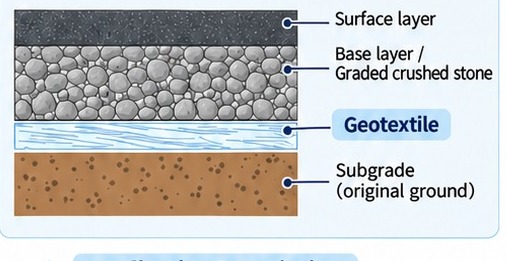
Roads & Railways
Keep granular layers separated from the subgrade while addressing filtration and construction damage.
Explore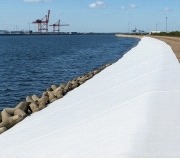
Water Storage & Canal Systems
Define whether the task is liquid containment, filter protection, surface erosion control or a combination.
Explore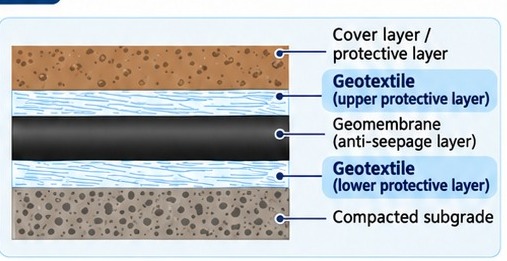
Mining & Environmental Containment
Separate barrier performance, mechanical protection and drainage in waste or mining systems.
Explore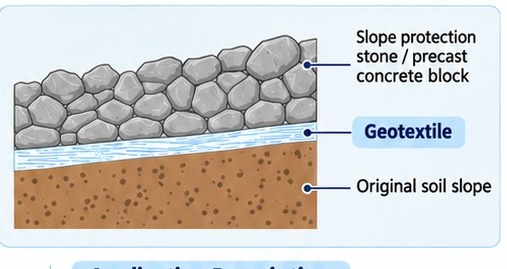
Slopes, Riverbanks & Coastal Protection
Choose the protection system around erosion, hydraulic conditions and slope stability.
Explore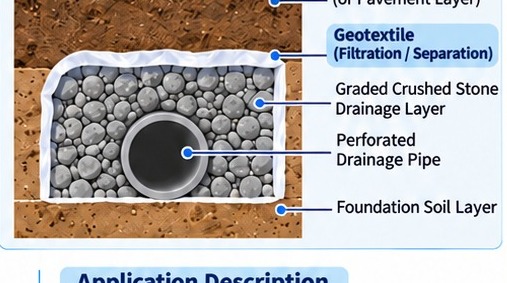
Municipal & Subsoil Drainage
Limit migration of fine soil into granular drainage and perforated-pipe systems.
Explore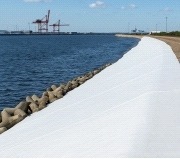
Aquaculture & Landscape Water Storage
Identify a liner construction compatible with pond geometry, water quality and maintenance.
Explore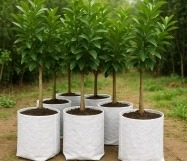
Geobags for Ecological Restoration
Use a filled-bag configuration with compatible planting media and surface protection.
ExploreBefore you buy
PET or PP Geotextile: Define the Environment Before the Polymer
Choose PET or PP geotextile against the contact environment and the required function, not the polymer name alone. PET means polyester and PP means polypropylene. Neither label identifies the complete finished-fabric specification. For a purchasing decision, separate the chemistry question from hydraulic and mechanical qualification: a material considered suitable for the exposure still needs evidence for its separation, filtration or protection duty.
ExploreStaple Fiber or Continuous Filament: Compare the Actual Specification
Choose staple-fibre or continuous-filament needle-punched geotextile by comparing the offered constructions against the project duty. Staple fibres form one type of entangled web; continuous filaments form another. Those names describe construction, not a universal ranking in strength, filtration performance or long-term suitability.
ExploreReading a Geotextile Table: Strength, Puncture, Opening Size and Flow
Read a geotextile table as a set of separate answers: mass and thickness describe aspects of construction; tensile and puncture address different mechanical questions; opening size and flow data address different hydraulic questions. A purchasing decision should match each required property to its method, units, value basis and offered grade. A single mass or strength number cannot replace that schedule.
ExploreProtecting a Geomembrane: Below, Above or Both Sides
Identify the contact being protected before deciding whether a geomembrane needs geotextile below, above or on both sides. A lower layer and an upper layer can address different damage exposures. Their positions, constructions and acceptance basis should follow the lining-system design; fabric weight alone cannot approve the protection arrangement.
ExploreA Sample Test Report Is Different from a Brochure Range
A sample test report describes the specimen and tests identified in that report. A brochure describes a product family or claimed capability. Procurement needs both context and traceability: identify what was tested, what is being offered and which project requirements the evidence actually answers. Neither a laboratory logo nor a strong result fills in missing scope.
Explore