GEOSYNTHETICS · TECHNICAL NONWOVENS
APPLICATIONS

Mining & Environmental Containment

Separate barrier performance, mechanical protection and drainage in waste or mining systems.

INDUSTRY CONTEXTWater, Land & Environmental Systems ↗
Mining & Environmental Containment — brochure application reference
Application reference from company-supplied literature. Illustrative context; project design and material suitability require confirmation. Not a verified BOSHIDA project.

The buyer’s starting question

Separate barrier performance, mechanical protection and drainage in waste or mining systems.

Material position in the system

Landfill base/cap, leachate pond, tailings and heap-leach conditions require different review.

Conditions that change the specification

Medium composition and concentration, temperature, exposure time, loading, subgrade, interfaces and project specification. Record these inputs before using brochure ranges or requesting a comparable offer.

Compare material candidates

Use the linked products to compare construction, reference dimensions and required verification. Confirm the exact grade and documentation rather than selecting by a category name alone.

Evidence and acceptance

Ask for a proposed specification, identified sample, relevant method and results applicable to the intended construction. Literature and illustrative pictures are not proof of a completed project or customer approval.

Application boundary

Generic chemical resistance does not establish compatibility with every leachate or process liquid.

Prepare the procurement brief

Provide the drawing or component description, site/process conditions, target properties, test requirements, quantity, destination and schedule. Distinguish the supplied material from the responsibilities of the system designer or finished-product manufacturer.

Source & applicability

Supplier literature supports this selection brief. Reference ranges do not establish an approved grade, certification or tested system performance.

CONTINUE SELECTING

Related technical guides

01 / BUYING GUIDE
Technical resources

PET or PP Geotextile: Define the Environment Before the Polymer

Choose PET or PP geotextile against the contact environment and the required function, not the polymer name alone. PET means polyester and PP means polypropylene. Neither label identifies the complete finished-fabric specification. For a purchasing decision, separate the chemistry question from hydraulic and mechanical qualification: a material considered suitable for the exposure still needs evidence for its separation, filtration or protection duty.

Explore
02 / BUYING GUIDE
Technical resources

Smooth or Textured HDPE: Start with the Contact Interfaces

Choose smooth or textured HDPE geomembrane from the interfaces in the designed lining system. Name the material touching each face, the location on the drawing and the relevant loading and moisture conditions. Texture is a surface configuration; its appearance alone does not demonstrate interface resistance or establish that a slope is safe.

Explore
03 / BUYING GUIDE
Technical resources

Specify Composite Membrane Layers Instead of Total Mass Alone

Specify a composite geomembrane layer by layer: membrane material and thickness, fabric identity and mass per area on each side, overall dimensions and the intended joining detail. A total mass such as “500 g/m² composite” does not uniquely identify the barrier layer or establish that two offered constructions are equivalent.

Explore
04 / BUYING GUIDE
Technical resources

Staple Fiber or Continuous Filament: Compare the Actual Specification

Choose staple-fibre or continuous-filament needle-punched geotextile by comparing the offered constructions against the project duty. Staple fibres form one type of entangled web; continuous filaments form another. Those names describe construction, not a universal ranking in strength, filtration performance or long-term suitability.

Explore
05 / BUYING GUIDE
Technical resources

Reading a Geotextile Table: Strength, Puncture, Opening Size and Flow

Read a geotextile table as a set of separate answers: mass and thickness describe aspects of construction; tensile and puncture address different mechanical questions; opening size and flow data address different hydraulic questions. A purchasing decision should match each required property to its method, units, value basis and offered grade. A single mass or strength number cannot replace that schedule.

Explore
06 / BUYING GUIDE
Technical resources

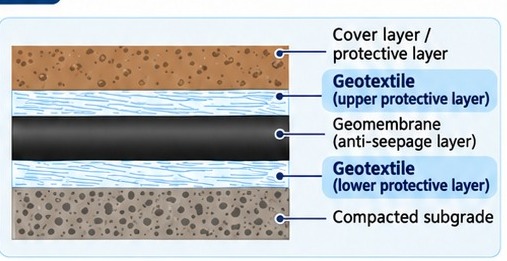
Protecting a Geomembrane: Below, Above or Both Sides

Identify the contact being protected before deciding whether a geomembrane needs geotextile below, above or on both sides. A lower layer and an upper layer can address different damage exposures. Their positions, constructions and acceptance basis should follow the lining-system design; fabric weight alone cannot approve the protection arrangement.

Explore
07 / BUYING GUIDE
Technical resources

Studded or Spray-Textured: What Evidence Makes a Fair Comparison?

Studded and spray-textured geomembranes have visibly different surface patterns, but a texture name or photograph does not establish which finish is appropriate for a project interface. Compare the offered membrane, the actual contact pair and the supporting test conditions. Treat the surface description as product identification, not an automatic ranking of stability.

Explore
08 / BUYING GUIDE
Technical resources

HDPE Resin, Thickness and Color: Three Separate Procurement Decisions

Resin requirements, membrane thickness and colour are three separate decisions in an HDPE geomembrane enquiry. None of them alone proves overall quality or suitability for a particular liquid or exposure. Specify what each field is intended to control, then link the offered construction to the appropriate product documents and project evidence.

Explore
09 / BUYING GUIDE
Technical resources

Geomembrane Installation Review: Deployment, Welding and Seams

A geomembrane installation review should distinguish prepared-base acceptance, panel deployment, joining and seam verification. Material procurement and installation quality are related but are not interchangeable. A factory product report does not establish that a field seam or a completed lining area has been accepted. The project’s approved installation and quality documents must identify who checks each stage.

Explore
10 / BUYING GUIDE
Technical resources

A Sample Test Report Is Different from a Brochure Range

A sample test report describes the specimen and tests identified in that report. A brochure describes a product family or claimed capability. Procurement needs both context and traceability: identify what was tested, what is being offered and which project requirements the evidence actually answers. Neither a laboratory logo nor a strong result fills in missing scope.

Explore
START WITH THE REQUIREMENT

Bring us your material brief.

Project specifications, converting requirements or a reference sample.

Start an inquiry ↗