Editorial purchasing guidance based on the cited sources. Product suitability and acceptance criteria require project-specific review; this article is not an engineering approval.
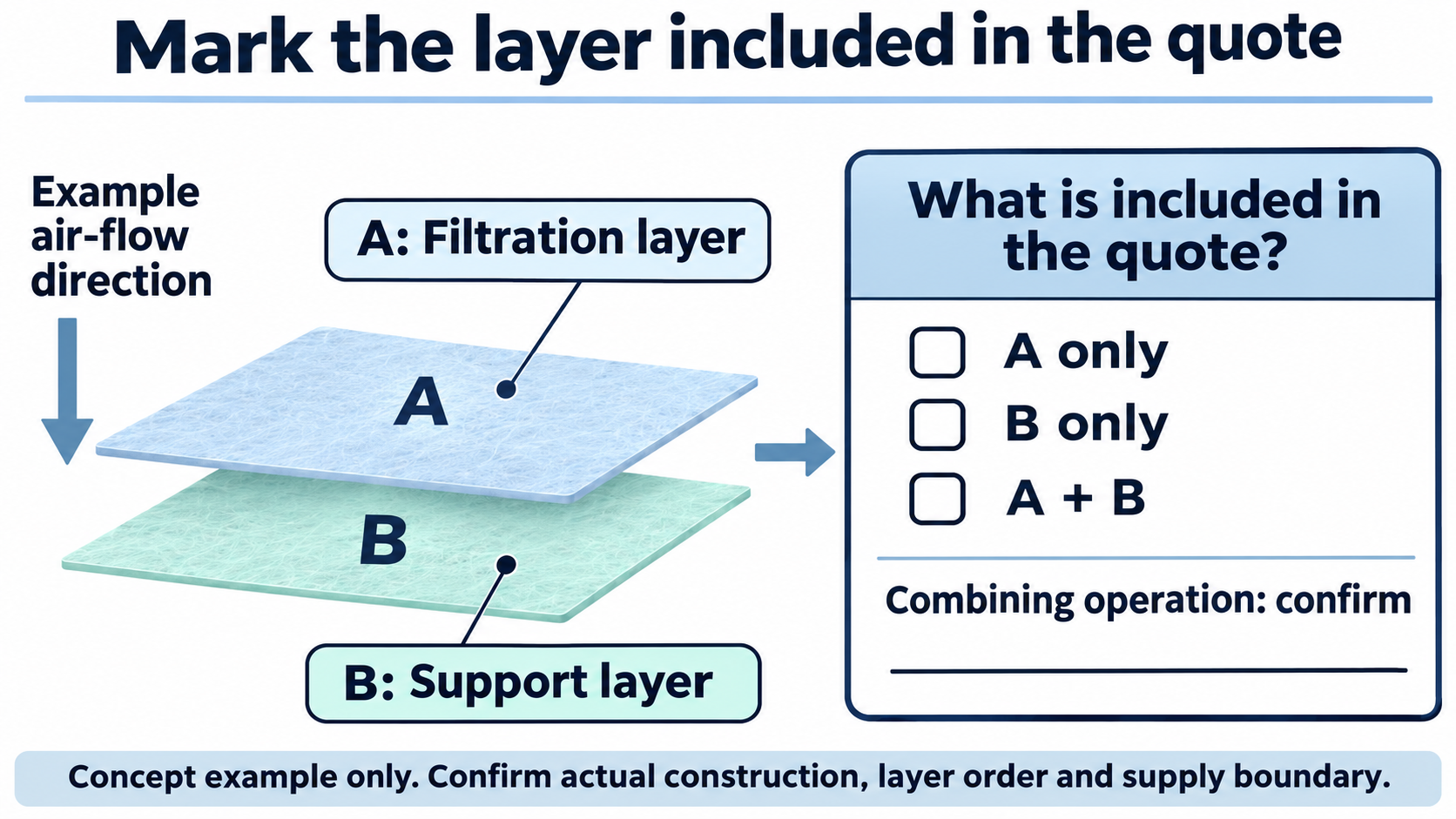
Specify the layer being purchased before asking for a price. In a multilayer air-filter construction, a support or backing layer and a filtration layer can have different assigned jobs. Mark the requested layer on a stack drawing and state whether the offer covers that layer alone or a supplied combination. The checklist below is an editorial purchasing aid; the buyer’s engineer must confirm the actual construction.
Why do the layer names matter?
FSA’s exhibitor profile describes Freudenberg air-filtration support layers as spunbond backing and support for filtration media. Freudenberg’s own portfolio separately lists Media and complementary Support products. These descriptions establish distinct product roles within that supplier’s range; they do not establish a universal two-layer design. [1, 2]
Use the supplier’s terminology as a question to resolve, rather than as a substitute for a drawing. Ask which named layer the quotation includes. A description such as “pleatable material” leaves that purchasing identity unanswered: it may describe a processing requirement without naming the layer to be delivered.
What should a layer-specific RFQ identify?
RFQ means request for quotation. For this enquiry, propose one row for each layer or supplied combination. The buyer can attach a simple stack sketch with an air-flow arrow and labels matching the rows. This is a suggested documentation format, not a required filter architecture.
Layer label: identify the position using the buyer’s drawing reference. Requested item: name the single layer or combined material being quoted. Assigned job: describe the intended backing, support or filtration task in the buyer’s design. Supply boundary: state whether lamination or another combining operation is included, performed elsewhere or still undecided.
For a combined offer, ask the supplier to identify every included layer and any excluded operation. For a single-layer offer, ask which adjoining layer or converter interface remains outside the price. The aim is to compare quotations for the same delivery boundary, rather than to compare prices that cover different portions of a stack.
Which evidence belongs beside each requested job?
Separate the questions about converting the layer from those about its assigned filtration task. For a proposed support layer, ask the converter which evidence is needed for handling and forming it in the intended combination. For a filtration layer, ask the buyer’s engineer to identify the applicable performance question, test object and method. These are enquiries to resolve; this article prescribes no performance limits.
Add an evidence-owner column to the RFQ. A material supplier may provide layer documents, a converter may provide records for a supplied combination, and the buyer may hold the design requirements. Confirm those responsibilities rather than assuming that a supplier quoting one layer is also quoting every other layer’s validation.
If a report covers several layers together, record that tested stack beside the report. Ask the engineer how it relates to the quoted layer. Do not relabel a stack result as a standalone property of one constituent. If the answer is unavailable, keep the relevant RFQ field open instead of filling it with a value from a different product.
How can two suppliers quote the same layer boundary?
Send both suppliers a stack drawing with consistent layer labels and mark the layer or combination being requested. Use a separate field for any joining or converting operation included in the price. A layer quote and a combined-material quote can both be useful, but their scope must be explicit before comparing them.
For each offer, write the requested task beside the evidence being supplied: supporting or backing the neighbouring medium, performing the stated filtration duty, or delivering an agreed combination. If a supplier uses a different product name, ask it to map that name to the buyer’s layer label. This avoids accepting a plausible term as proof that both suppliers priced the same object.
Illustrative quote comparison: support only versus combined supply
Supplier A quotes a backing layer; supplier B quotes a supplied combination that also includes filtration media. Ask both to identify included materials, converting operations and evidence responsibility. The prices do not become directly comparable merely because both offers use “pleatable filter material.” No particular architecture or supplier capability is implied by the example.
Next step
Send a labelled stack sketch and the completed layer-role fields with your enquiry. For related BOSHIDA material discussions, see Industrial Filtration & Custom Felts. That link identifies a relevant product family; availability of a specific support-layer construction requires separate confirmation.
Frequently asked questions (FAQ)
Can one supplier quote both the support and filtration layers?
Yes, the RFQ can invite a combined offer. Ask for the included layer labels and combining operations to be itemised so it can be compared with a single-layer offer on the same scope. This is a proposed quoting format, not a statement about any supplier’s capability.
Does a stiff support layer establish filtration efficiency?
No standalone efficiency result follows from stiffness. Ask what object was tested and which layer or combination the performance statement concerns.
Can an air-permeability result stand in for a filter efficiency class?
No automatic equivalence is established. Identify the method, specimen and performance question; do not rename one reported quantity as another.
Does BOSHIDA’s needle-punched product page prove spunbond support capability?
No. The product link identifies a related enquiry route only. Ask for the actual offered construction and evidence before describing a particular support layer as available or equivalent.
What should be written if lamination is excluded from a layer quote?
State that boundary beside the quoted layer and identify who supplies or performs the combining operation. This prevents a single-layer price from being mistaken for the price of a ready-to-convert multilayer material.
Can the same layer name identify different materials from different suppliers?
A shared name is not sufficient product identification. Ask each supplier to map its offered construction to the buyer’s labelled layer and required job, with the corresponding specification and evidence scope.
Reference: FSA 2026 exhibitor profile: Freudenberg
Reference: Freudenberg filter media portfolio