
Transport & Civil Infrastructure
Define the layer position, subgrade, drainage and installation demands before choosing a geotextile.
Choose the application position
What the buyer needs to decide
Road and rail procurement teams need the drawing position, soil/fill grading, construction loads and hydraulic requirements to be explicit. A fabric selection cannot establish the capacity of the complete structure.
Build a comparable technical request
Use the application map below to choose the material family, then open the individual product type for construction, reference ranges, limitations and source documents. Record unknown inputs rather than assuming the maximum values form one available grade.
Evidence and supply scope
Request the proposed commercial grade, applicable specification/version, relevant sample or batch evidence, and manufacturing or coordinated supply responsibility. These routes describe procurement contexts, not verified customer projects or universal suitability.
Source & applicability
Supplier literature supports this selection brief. Reference ranges do not establish an approved grade, certification or tested system performance.
Check the material against the application
| Application | Buyer’s task | Candidate materials | Conditions to define |
|---|---|---|---|
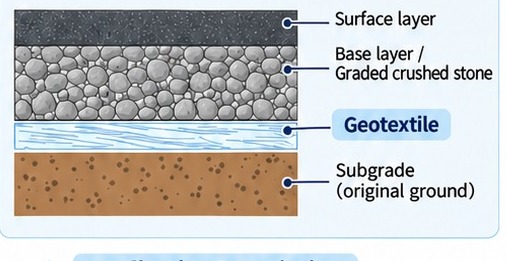
| Roads & Railways | Keep granular layers separated from the subgrade while addressing filtration and construction damage. | Soil grading, fill type, installation loading, drainage path, tensile/puncture and filter compatibility. Record these inputs before using brochure ranges or requesting a comparable offer. | |
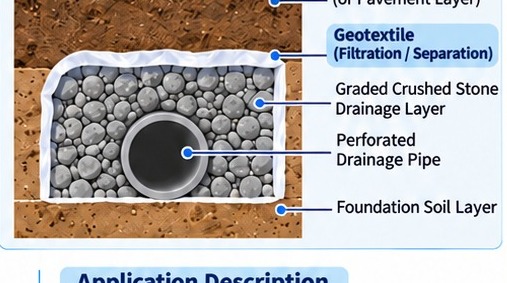
| Municipal & Subsoil Drainage | Limit migration of fine soil into granular drainage and perforated-pipe systems. | Soil particle grading, opening size, hydraulic flow, drain geometry and construction survival. Record these inputs before using brochure ranges or requesting a comparable offer. |
Explore the related material range
Prepare the evidence and selection package
Editable selection briefs
Fill the inputs you know. A request worksheet is different from a data sheet or test report.
Needle-Punched Geotextiles brief ↗Released original literature
No original technical file for this platform is currently released for public download. Product pages retain the supplied reference data and source scope.
Browse released technical resources ↗Grade-specific evidence
Request the offered identifier, effective TDS, sample or batch results and permission to share. Certification and complete-system performance require their own evidence.
Request the applicable documents ↗How to review evidence ↗Compare before preparing a request
PET or PP Geotextile: Define the Environment Before the Polymer
Choose PET or PP geotextile against the contact environment and the required function, not the polymer name alone. PET means polyester and PP means polypropylene. Neither label identifies the complete finished-fabric specification. For a purchasing decision, separate the chemistry question from hydraulic and mechanical qualification: a material considered suitable for the exposure still needs evidence for its separation, filtration or protection duty.
ExploreStaple Fiber or Continuous Filament: Compare the Actual Specification
Choose staple-fibre or continuous-filament needle-punched geotextile by comparing the offered constructions against the project duty. Staple fibres form one type of entangled web; continuous filaments form another. Those names describe construction, not a universal ranking in strength, filtration performance or long-term suitability.
ExploreReading a Geotextile Table: Strength, Puncture, Opening Size and Flow
Read a geotextile table as a set of separate answers: mass and thickness describe aspects of construction; tensile and puncture address different mechanical questions; opening size and flow data address different hydraulic questions. A purchasing decision should match each required property to its method, units, value basis and offered grade. A single mass or strength number cannot replace that schedule.
ExploreExplore 2 more related guides
Protecting a Geomembrane: Below, Above or Both Sides
Identify the contact being protected before deciding whether a geomembrane needs geotextile below, above or on both sides. A lower layer and an upper layer can address different damage exposures. Their positions, constructions and acceptance basis should follow the lining-system design; fabric weight alone cannot approve the protection arrangement.
ExploreA Sample Test Report Is Different from a Brochure Range
A sample test report describes the specimen and tests identified in that report. A brochure describes a product family or claimed capability. Procurement needs both context and traceability: identify what was tested, what is being offered and which project requirements the evidence actually answers. Neither a laboratory logo nor a strong result fills in missing scope.
ExploreQuestions buyers ask in this industry
Turn the application into a technical request
Open a product type to review its sources and fill its editable technical brief. Keep unknown values marked for confirmation.
Find and shortlist materials ↗ Discuss this industry requirement ↗