Choose furniture hardfelt, base fabric or spring-pocket fabric by the component’s job, not by applying one fabric weight across the furniture. The supplied literature describes different material routes for stiffer support, bottom-cover or support duties, and wrapping individual springs. Each route needs its own assembly and evidence questions.
Which duty points toward each material route?
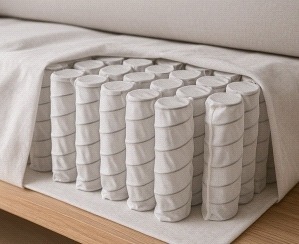
A hardfelt discussion should identify the support shape and stiffness needed. A base-fabric discussion should say whether the underside layer is mainly a dust cover or is expected to contribute to support. A spring-pocket discussion needs the spring geometry, pocket design and joining method. These are application distinctions, not a claim that every product in a route meets every finished-furniture requirement.
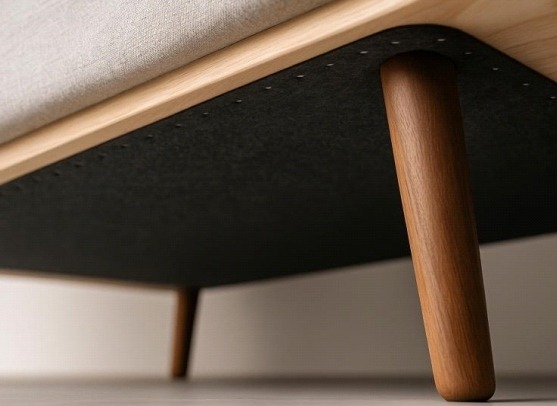
Show the layer in the furniture drawing. Calling all three materials “furniture nonwoven” is useful for a broad search but leaves too much interpretation in a purchasing specification.
Which properties should be compared within a route?
For a support board or hardfelt, discuss the forming or bending conditions and the required finished behaviour. For a base fabric, identify attachment, air movement, tears and the actual duty. For a pocket fabric, consider feed behaviour, seam formation and assembly verification. The right comparison retains those different tasks rather than ranking the materials by tensile strength alone.
Evaluate the proposed finished assembly where required. A strip property does not establish the strength of a stapled attachment, a formed panel or a welded pocket.
How should comfort and environmental statements be treated?
State the actual question: noise, odour, emissions, restricted substances or another customer criterion. Request the method, specimen and evidence applicable to the offered construction. A general E0 or eco-friendly phrase should not approve three unrelated product types.
Where adhesives, coatings or other layers are involved, identify whether the evidence concerns the raw nonwoven or the finished combination. Keep unverified claims out of the purchase comparison.
Example: an underside cover is not automatically a load-bearing layer
A furniture buyer replaces a bottom-cover fabric and asks for “stronger material.” First establish whether the layer is intended to carry a load or mainly cover the underside. Then identify attachment and service conditions. Upgrading a fabric’s nominal tensile figure does not, by itself, define a new structural role.
Next step
Compare furniture nonwoven materials by component, then use the spring-pocket trial guide where welded pockets are involved.
Frequently asked questions (FAQ)
Can one nonwoven be used throughout a sofa or mattress?
Only a component-by-component review could establish that. Similar appearance or mass does not demonstrate suitability for support, cover and spring-pocket duties simultaneously.
Is furniture base fabric always load-bearing?
Do not infer that from the category name. State whether the design assigns a support duty and ask for the corresponding material and attachment evaluation.
Does quiet fabric prove a quiet finished mattress?
No universal conclusion is established. Friction, springs and assembly can be part of the finished-system question. Request the relevant test or trial instead of assigning the outcome to one fabric label.
When should pocket-fabric machine compatibility be checked?
Before treating the material as approved for production. Identify the actual joining route and representative trial, using the proposed fabric and pocket configuration.
Can a base-fabric sample qualify the finished staple attachment?
Not by itself. The attachment includes its own geometry and assembly conditions. Identify the relevant finished-component evaluation instead of treating a fabric strip result as approval for every fastening arrangement.
How should an odour or emissions requirement be written for furniture material?
Name the actual material or assembly and the customer’s method and acceptance requirement. Identify adhesives or other layers where relevant. A broad eco-friendly phrase does not resolve the evidence needed for the finished application.
Source & applicability
Supplier literature supports this selection brief. Reference ranges do not establish an approved grade, certification or tested system performance.