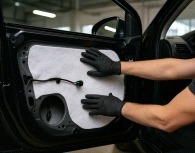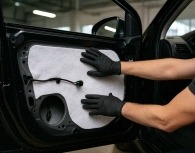
An automotive nonwoven enquiry needs a component and processing brief before a catalogue property range. Door trim, headliner, carpet and trunk parts do not automatically share the same material requirement. Define the layer’s role and the forming or laminating operation, then identify the customer’s actual performance and approval requirements for that component.
Where does the material sit in the component?
Name the part and show the nonwoven’s position in its build-up. State whether it is being considered for support, surface, acoustic or thermal functions, and describe adjacent layers. The supplied automotive literature introduces several potential uses; it does not establish approval for every vehicle programme.
Separate the requested roll material from a formed or laminated component. A flat sample and a completed part are different objects, and a quotation must say which operations and dimensions the supplier is being asked to deliver.
Which process inputs belong in the trial brief?
Identify the intended forming, bonding or laminating route and the information the converter can provide about the actual operation. Ask for the properties needed to feed, form and retain the intended shape, as applicable to the part. Keep mass, thickness and stiffness targets tied to the component rather than treating a broad brochure range as a ready-made recipe.
If the trial includes another layer or adhesive, identify that combination. A change in the composite can change what must be evaluated even when the needle-punched base remains the same.
How should acoustic, emissions and fire questions be handled?
Record the required method, sample form and customer acceptance basis for each question. A generic noise-reduction coefficient, VOC number or fire phrase does not establish compliance with every OEM requirement. VOC means volatile organic compounds; its measurement depends on the specified test and sample conditions.
The buyer should identify the applicable customer requirement and obtain evidence for the offered material or assembly as required. This guide does not supply vehicle approval, an emissions threshold or a forming temperature.
Example: avoid approving a whole part from a flat swatch
A converter likes the feel of a sample intended for a trunk component. Record that observation, but identify separately the forming trial, composite evaluation and customer tests still needed. A favourable hand-feel comparison does not establish dimensional behaviour, acoustic performance or a completed-part approval.
Next step
Send a part drawing and processing brief through the automotive nonwoven enquiry. For sample traceability, use the OEM sampling guide.
Frequently asked questions (FAQ)
Does one acoustic figure describe every installation position?
No universal equivalence is established. Match the test object and conditions to the component question and obtain the appropriate evaluation for the intended build-up.
Can the brochure forming temperature be used as a line setting?
Do not use a family reference as an automatic machine recipe. Confirm the offered construction and run the converter’s appropriate process verification.
Does a recycled-fibre claim establish vehicle approval?
No. Composition or sourcing statements and component performance approval are different matters. Identify the traceability and performance records actually required by the customer.
Can the supplier be described as OEM-approved from an application page?
No. An application description does not establish a named programme approval. Use only documented supplier or component approvals within their actual scope.
Should an acoustic requirement be checked on bare fabric or the component?
Have the customer technical contact identify the required test object and method. Keep a bare-material result and a formed or laminated component result distinct; their applicability depends on the actual customer question.
What information helps investigate a forming problem?
Record the sample identity, part geometry, layers and the actual processing conditions the converter can share. Describe the observed distortion, break or other issue before assigning it to one material feature. A catalogue range does not identify the cause.
Source & applicability
Supplier literature supports this selection brief. Reference ranges do not establish an approved grade, certification or tested system performance.